

3Q2026 Quarterly Insights Newsletter
U.S. Equities
Main Points
-
The S&P 500 gained roughly 2% despite a challenging backdrop of higher interest rates.
-
Style leadership shifted notably as value stocks outperformed growth.
-
Third-quarter performance reflected an equity market supported by solid fundamentals.
U.S. Sectors
Main Points
-
Sector gains were concentrated in Technology and Energy, masking market weakness.
-
Energy emerged as the strongest-performing sector, rebounding sharply due to higher oil prices.
-
Despite narrowing leadership, sector trends remained broadly cyclical rather than defensive.
U.S. Economy & Fixed Income
Main Points
-
The U.S. economy in Q3 remained resilient despite higher interest rates and geopolitical uncertainty.
-
Inflation pressures prompted the Federal Reserve to begin a new tightening cycle.
-
The Bloomberg U.S. Aggregate Float Adjusted Index lost 3.4%, its worst quarterly return in four years.
International Equities
Main Points
-
Global equities posted modest gains in the third quarter despite a historically weaker seasonal period.
-
Asia Pacific ex Japan was the best-performing region, gaining 2.8%. Meanwhile Europe saw mixed results.
-
Technology performance became more mixed with continued investment in artificial intelligence.
Commodities
Main Points
-
Commodities delivered strong third-quarter performance, with the broad commodity complex rising 18%.
-
Historically, commodity markets have often continued to advance following the initial stages of monetary tightening.
-
Commodity breadth has improved significantly since mid-year, indicating participation has expanded.
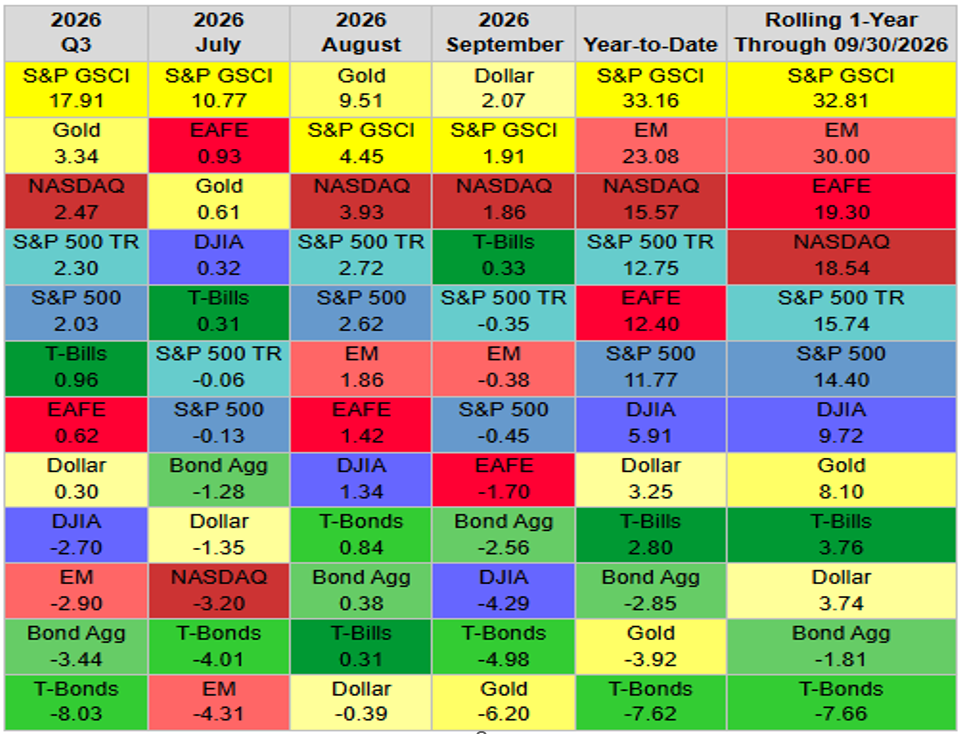
Q3 Asset Class Benchmark Returns
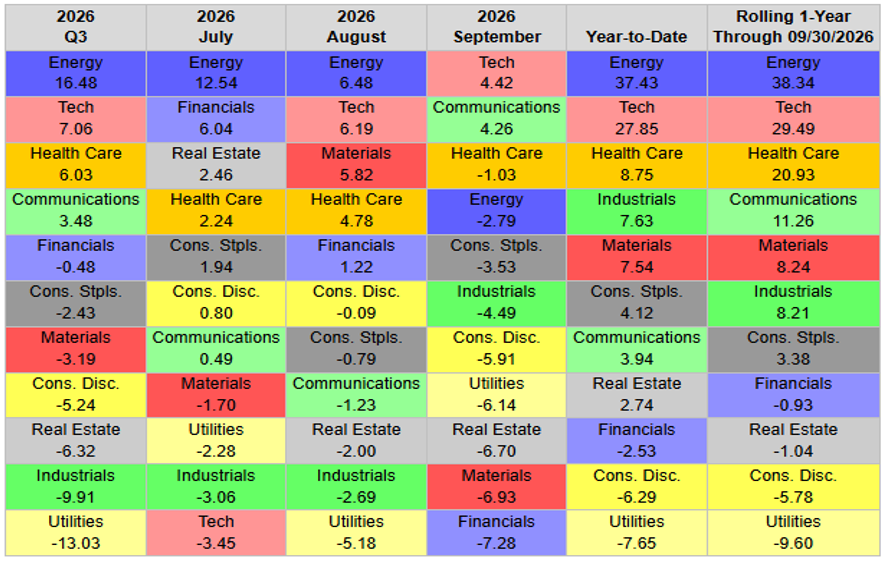
Q3 S&P 500 Sector Returns
U.S. equities delivered a resilient third quarter, with the S&P 500 gaining roughly 2% despite a challenging backdrop of higher interest rates, elevated Treasury yields, persistent geopolitical tensions, and surging commodity prices. While returns were well below the strong gains recorded in the second quarter, markets continued to advance as earnings expectations remained supportive and investors maintained confidence in the expansion. Overall, third-quarter performance reflected resilient fundamentals despite tighter financial conditions, higher yields, and increasingly concentrated market leadership.
Performance beneath the surface was far less uniform. Large-cap stocks significantly outperformed both mid- and small-cap equities, as investors favored companies with stronger earnings growth and greater exposure to secular investment themes, particularly artificial intelligence and digital infrastructure.
Style leadership shifted as value stocks outperformed growth across market-cap segments. Rising interest rates created valuation pressure on more rate-sensitive growth companies, while economically-sensitive value sectors benefited from stronger nominal growth. Even so, returns remained concentrated among larger companies, highlighting continued investor preference for scale, profitability, and earnings durability.
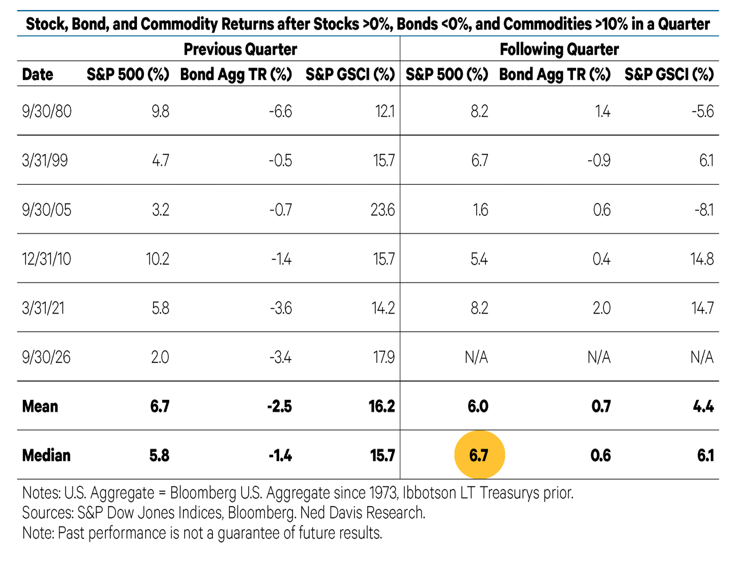
The quarter was also notable for an unusual divergence across asset classes. Commodities surged more than 17%, broad bond markets declined, and equities still posted gains. This combination of stocks rising, bonds falling, and commodities gaining more than 10% has occurred only five other times since 1970 (table below).
Historically, those episodes did not foreshadow immediate challenges for risk assets. In every instance, the S&P 500 advanced during the following quarter, generating a median gain of 6.7%.
Rare combo of stock, bond & commodity returns
Source: Ned Davis Research (NDR)
U.S. sector performance shifted dramatically during the third quarter, highlighting a market driven by a handful of leadership groups rather than broad participation. While the S&P 500 gained roughly 2%, gains were concentrated in Technology and Energy, masking weakness across much of the market.
Energy emerged as the strongest-performing sector, rebounding sharply as higher oil prices and renewed geopolitical tensions supported commodity markets. Technology also delivered strong returns and was the largest contributor to overall index performance, reflecting continued enthusiasm for artificial intelligence, digital infrastructure, and semiconductor-related spending. Together, these sectors accounted for most of the market's advance. In contrast, several interest rate-sensitive sectors struggled as long-term Treasury yields climbed to multi-decade highs. Utilities and Real Estate were among the weakest performers, while various consumer-oriented industries also faced pressure. Performance dispersion remained elevated across sectors, underscoring the increasingly selective nature of the market.
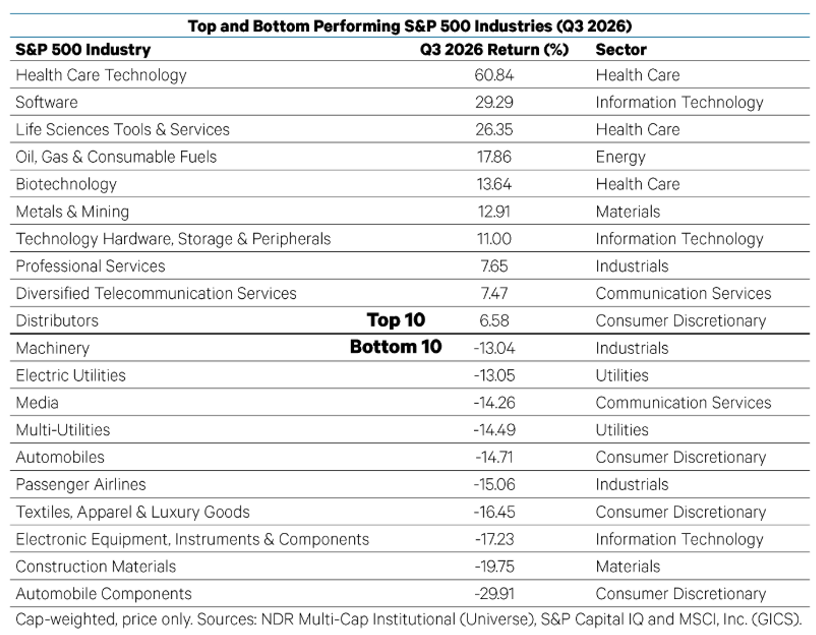
Beneath the headline gains, market breadth deteriorated throughout the quarter. Equal-weighted benchmarks lagged significantly behind capitalization-weighted indexes, indicating that a relatively small group of large companies drove much of the S&P 500's performance.Q2’s top performers were concentrated, but Q3 was more balanced, with the top 10 spanning seven sectors. Health Care Technology was the biggest standout (table below). Despite narrowing leadership, sector trends remained broadly cyclical rather than defensive.
The sustainability of the rally will depend on leadership broadening beyond Technology. Without greater participation from other cyclical sectors, any slowdown in AI-driven leadership could create market headwinds in Q4.
Big divergence between winners and losers in Q3
Source: Ned Davis Research (NDR)
The U.S. economy remained resilient throughout the third quarter despite higher interest rates, elevated energy prices, geopolitical uncertainty, and ongoing affordability pressures. Economic activity continued to be supported by a healthy labor market, firm consumer spending, and a robust capital expenditure cycle led by artificial intelligence, digital infrastructure, and industrial investment. Growth remained above trend, helping sustain corporate earnings and reducing near-term recession concerns.
However, persistent inflation pressures, fueled by strong demand and higher energy costs, prompted the Federal Reserve to begin a new tightening cycle. While inflation moderated modestly during the quarter, it remained well above the Fed's target. This reinforces expectations that policy rates may stay elevated for longer and financial conditions remain restrictive.
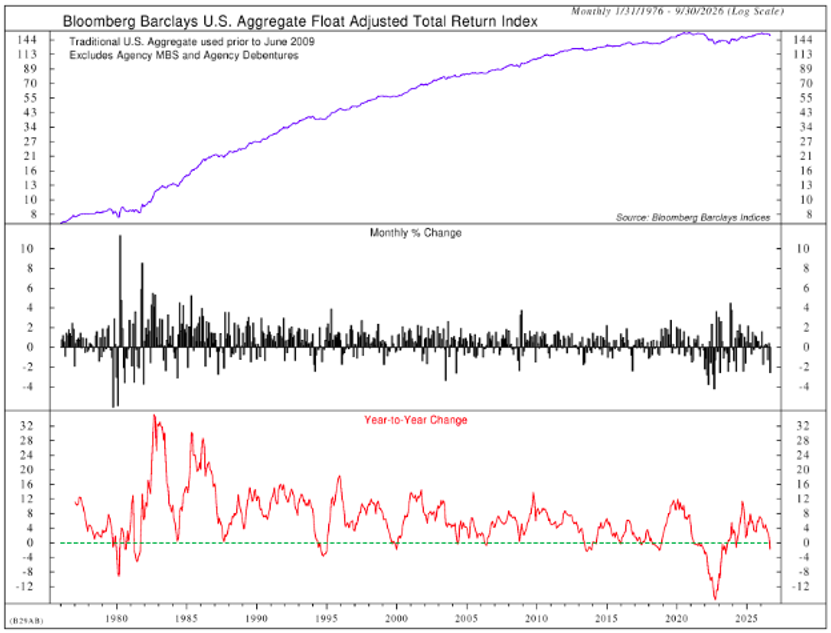
Fixed income markets faced a far more challenging environment. Anticipation of tighter monetary policy, stronger economic growth, and persistent inflation pushed Treasury yields sharply higher, with the 10-year Treasury yield reaching its highest level since 2002. As a result, bonds experienced widespread losses during the quarter, with longer-duration assets bearing the brunt of the selloff. The Bloomberg U.S. Aggregate Float Adjusted Index lost 3.4%, its worst quarterly return in four years (chart below). Mortgages and municipal bonds also struggled amid rising rates. In contrast, floating-rate securities and leveraged loans delivered positive returns, benefiting from their limited interest-rate sensitivity.
Looking ahead, resilient growth, persistent inflation, and elevated energy prices could keep interest rates higher for longer, supporting income opportunities while maintaining pressure on longer-duration bonds and interest-rate-sensitive sectors.
U.S. bonds posted its worst quarter in four years
Source: Bloomberg
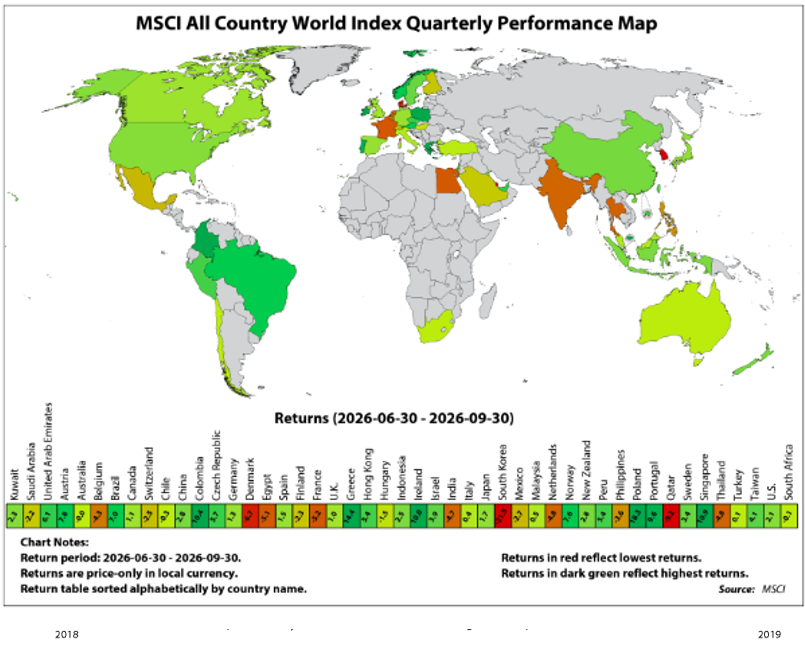
Global equities posted modest gains in the third quarter despite a historically weaker seasonal period and rising bond yields. Market performance was broadly positive, with 29 of 47 MSCI ACWI countries generating gains during the quarter (chart across), highlighting continued resilience in risk assets even as monetary policy became less supportive.
Leadership shifted away from the technology-driven rally that characterized the first half of the year. Energy was the strongest-performing sector as geopolitical tensions supported oil and gas prices, while Financials benefited from higher interest rates and resilient economic activity. Materials and mining-related equities also advanced alongside firmer industrial metals prices. Conversely, Real Estate and Consumer Discretionary lagged as investors adjusted to a higher-yield environment.
Technology performance became more mixed. Continued investment in artificial intelligence supported software and digital infrastructure companies, but semiconductor stocks retraced part of their outsized gains from earlier in the year. The pullback weighed on several technology-heavy markets and contributed to a broader rotation toward value-oriented sectors.
Regionally, Asia Pacific ex Japan was the best-performing region, gaining 2.8%, while emerging markets gave back some of their exceptional Q2 outperformance, losing 3.6%.
Meanwhile Europe saw mixed results as Energy and Financials oriented markets outperformed Technology-heavy economies.
Heading into year-end, international equity performance is likely to depend on whether earnings growth can offset the effects of higher interest rates, with market leadership expected to broaden if global growth remains resilient and inflation pressures gradually ease.
29 of 47 MSCI ACWI markets made gains in Q3
Source: Ned Davis Research (NDR)
Commodities delivered strong third-quarter performance, with the broad commodity complex rising 18%. Leadership came from Energy, which surged 32% as geopolitical tensions and refined-product shortages tightened markets. Agriculture advanced 14%, supported by both energy-related demand and tighter crop fundamentals, while Industrial Metals posted a more modest 5% gain. Despite these gains, inflation expectations have remained relatively contained, suggesting the rally reflects sector-specific supply and demand dynamics rather than a broad-based reflationary environment.
The outlook remains mixed. Historically, commodity markets have often continued to advance following the initial stages of monetary tightening. But rising real yields and a stronger U.S. dollar can create meaningful headwinds by tightening financial conditions and weighing on demand-sensitive markets. At the same time, commodities continue to offer diversification benefits as correlations with equities and bonds have shifted in recent months.
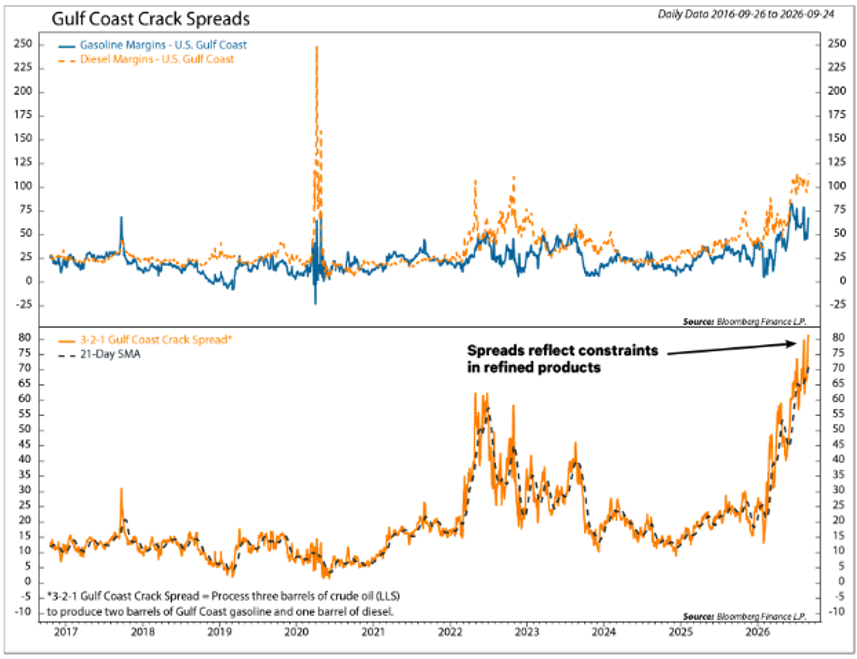
Beneath the strong headline performance, market drivers differ substantially across sectors. In Energy, refined-product scarcity remains a larger issue than crude supply alone. Tight diesel inventories, elevated refining margins, and limited spare refining capacity have kept product markets under pressure (chart below). Agriculture's rally has broadened beyond energy-linked demand, supported by tighter grain supplies and improving fundamentals across the soybean complex. Industrial Metals, particularly copper, have benefited from improving global manufacturing trends and constrained mine production. Overall, commodity breadth has improved significantly since mid-year, indicating participation has expanded across sectors, but mixed macroeconomic signals and an increasingly restrictive policy backdrop argue for a balanced outlook rather than a decisive bullish stance.
Crack spreads won’t crack
Source: Ned Davis Research (NDR)
Source: Ned Davis Research (NDR)
Source: Ned Davis Research (NDR)